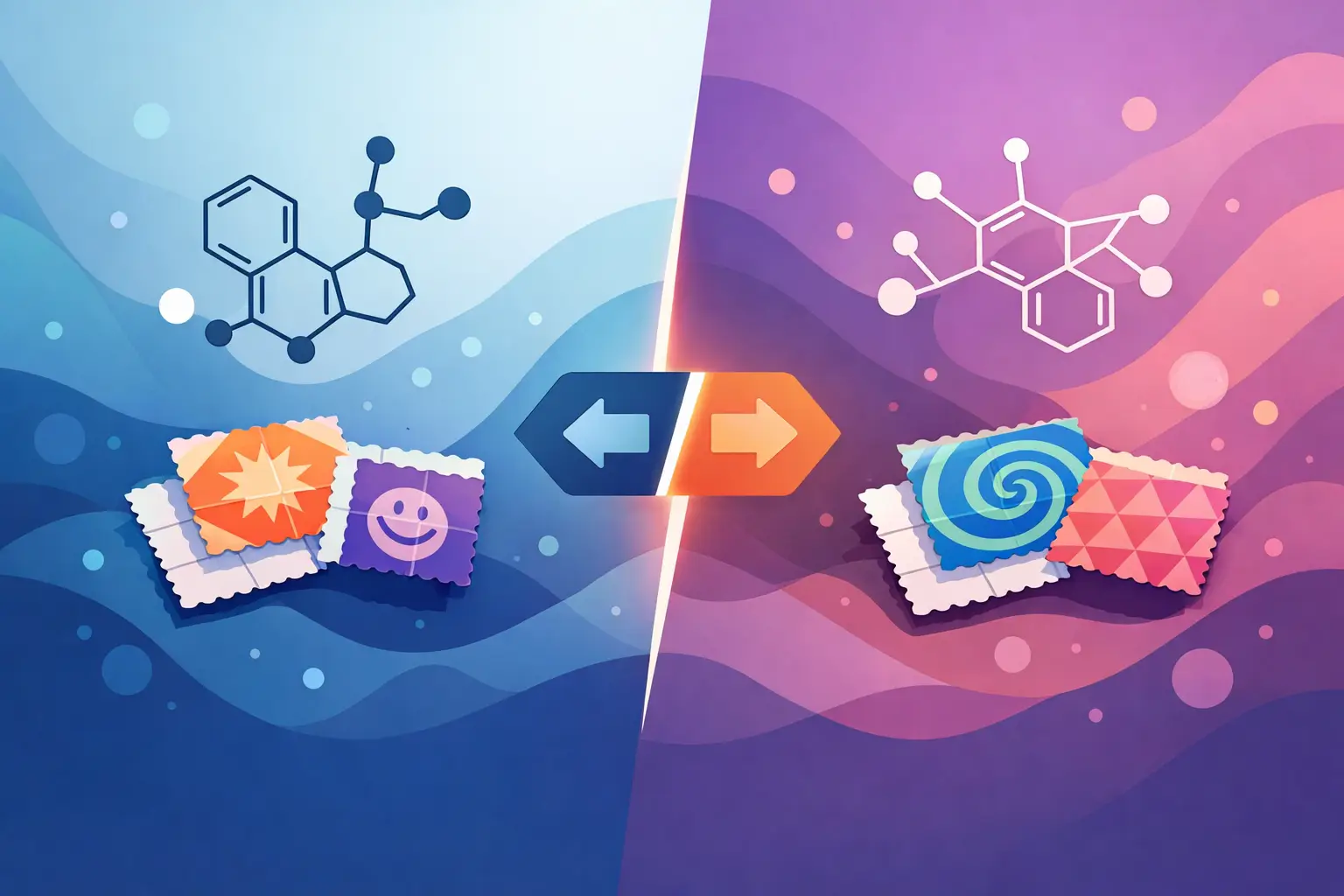
If you are comparing 1cP LSD vs LSD differences, you are probably not looking for hype. You want clean facts, realistic expectations, and enough detail to make a sharper call on what actually separates these two compounds in practice. That means getting past forum noise and looking at chemistry, pharmacology, timing, legality, and one factor that matters more than most people admit – source consistency.
What 1cP LSD and LSD have in common
At a glance, 1cP-LSD and LSD sit very close to each other. Both are lysergamides. Both are active at very low doses. Both are usually handled in blotter form, and both are discussed in the same circles because the subjective effects can overlap heavily.
That overlap is the reason this comparison gets messy. Many users report that 1cP-LSD feels extremely similar to LSD once effects are underway. Visual shifts, altered thought patterns, sensory enhancement, time distortion, and the typical psychedelic headspace all show up in ways that can feel familiar to experienced researchers.
So yes, the similarities are real. But similarity is not sameness, and that is where the useful distinctions start.
1cP LSD vs LSD differences in chemistry
The clearest technical difference is structural. 1cP-LSD is a 1-substituted analog of LSD. In simple terms, it carries an added cyclopropionyl group attached to the indole nitrogen. LSD does not.
That sounds minor, but small structural changes can affect how a compound behaves before, during, and after administration. In the case of 1cP-LSD, the main working theory is that it acts as a prodrug to LSD, meaning the body converts at least some of it into LSD after ingestion.
This matters because it helps explain why the experiences can feel so close while still not being perfectly identical in onset or intensity curve. If one compound must be metabolized into another active form, even partial conversion can introduce slight differences in timing and feel.
For buyers who care about precision, this is not just chemistry trivia. It is the reason you should not assume two blotters with similar labels will perform in exactly the same way, even when the destination effect profile overlaps.
Does 1cP-LSD turn into LSD?
Current evidence points in that direction. 1cP-LSD is widely understood to be metabolized into LSD in vivo. That is the central reason many researchers treat it as functionally close to LSD in effect profile.
But close does not mean interchangeable in every situation. The conversion rate, individual metabolism, stomach contents, dose size, and handling conditions can all influence how the experience unfolds. Two compounds can land in the same neighborhood while taking a slightly different route.
That is why experienced users often talk less about whether 1cP-LSD is “real enough” and more about whether the product is accurately dosed, properly stored, and sourced from a vendor that treats consistency as a baseline, not a slogan.
1cP LSD vs LSD differences in onset and duration
This is where users most often notice a practical split. LSD is usually described as coming on in a fairly direct way, though onset can still vary a lot by person and dose. 1cP-LSD is sometimes reported to have a slightly slower or smoother onset, likely because of that conversion step.
Not everyone notices this. Some people report no meaningful difference at all. Others say 1cP-LSD takes a bit longer to fully lock in, with a more gradual ramp before peak effects become obvious.
Duration can also feel close without being identical. Both compounds tend to run long compared with many other psychedelics. In real-world use, the bigger story is that both demand time, planning, and respect for the full arc of the experience. Anyone expecting a short session is looking at the wrong class of compound.
The trade-off is simple. If you value familiar lysergamide effects and are comfortable with slight variability in onset, 1cP-LSD may feel very workable. If you are comparing strictly by tradition and direct identity, LSD remains the reference point.
Subjective effects – similar, but not always identical
A lot of people want a clean winner here. There usually is not one.
Reports often describe 1cP-LSD as highly comparable to LSD in visual activity, cognitive stimulation, emotional amplification, and sensory changes. At moderate doses, many users would likely place them in the same category without hesitation.
Still, some differences do show up in user reports. A few describe 1cP-LSD as a touch smoother on the come-up. Others say it feels slightly lighter, cleaner, or less forceful at equivalent labeled doses. Some say there is no difference worth mentioning.
This is where dose accuracy becomes everything. If one blotter is underdosed, another is fresh and properly stored, and a third has seen heat or light degradation, people may think they are comparing 1cP-LSD and LSD when they are really comparing product quality. Bad comparisons happen all the time because the supply side is inconsistent.
That is exactly why lab-tested, verified material matters. In this category, quality control is not a bonus feature. It is the foundation for any meaningful research.
Legality is one of the biggest real-world differences
For many buyers, legality is the actual reason 1cP-LSD enters the conversation at all.
LSD is a controlled substance in the United States. 1cP-LSD exists in a more complex legal space because analog laws, state laws, and enforcement interpretations can create gray areas rather than simple yes-or-no answers. That does not make it risk-free. It means legal status can shift depending on jurisdiction and context.
This is where people get sloppy. They hear “analog” and assume safe access. That is not a serious way to assess risk. If legal exposure matters to you, check current federal and state frameworks, and understand that analog-related issues are fact-specific.
The practical point is this: legal status is not just about the molecule. It is about where you are, how laws are applied, and whether the product is represented, packaged, and sold with professionalism.
Testing, storage, and stability matter more than hype
When people talk about 1cP LSD vs LSD differences, they often focus on effects and ignore logistics. That is a mistake.
Blotter-based compounds are sensitive materials. Storage conditions can affect reliability. Heat, moisture, light, and rough handling can degrade product quality or create uncertainty around dose consistency. Even a strong compound becomes a weak purchase if the chain from production to delivery is sloppy.
That is why serious buyers look for clear dosing formats, lab-tested batches, and vendors that move fast and ship discreetly. Long delays, vague product descriptions, and poor handling standards create more variability than the chemistry itself.
For repeat buyers, consistency beats novelty. You want predictable blotters, stable inventory, and a seller that treats processing and packaging like part of the product. Official Chemistry King leans hard into that standard because reliable research starts before the first tab is even opened.
Which one feels “stronger”?
This depends on what you mean by stronger.
If you mean raw psychedelic character, many users would say the gap is narrow enough that dose, set, setting, tolerance, and batch quality matter more than the label alone. If you mean direct identity to LSD, then LSD is obviously the benchmark because it is the original compound rather than an analog believed to convert into it.
If you mean predictability from purchase to purchase, the answer may come down less to molecule choice and more to sourcing discipline. A carefully handled, accurately dosed 1cP-LSD product can outperform a questionable LSD source simply because quality control is tighter.
That is not a glamorous answer. It is the useful one.
Who should care most about the differences?
If you are brand new, the distinctions may matter less than the basics: dose discipline, environment, timing, and not treating potent lysergamides casually. The effects of either can be intense, long-lasting, and very sensitive to context.
If you are experienced, the finer points start to matter more. You may notice the onset profile, compare headspace texture, or care about legal positioning and product availability. You may also care about scaling purchases with confidence, especially if you are buying regularly and want less guesswork from one order to the next.
That is where the conversation gets real. Not every buyer is chasing some mythical perfect difference. A lot of people just want dependable material, fast processing, privacy, and product that performs like it is supposed to.
The smart way to think about 1cP LSD vs LSD differences
The smartest frame is not “Which one wins?” It is “What variables actually matter for my use case?”
If your priority is chemical identity, LSD is LSD. If your priority is a closely related lysergamide with a strongly overlapping profile, 1cP-LSD has a clear place in the market. If your priority is repeatable research, then testing, storage, dosing accuracy, and vendor reliability deserve just as much attention as the compound name on the listing.
That is the part people skip when they get distracted by hype. Precision beats mythology. Verified product beats guesswork. And when you are dealing with potent compounds active at tiny doses, small differences in chemistry matter – but small failures in quality control can matter even more.
The best call is the one made with clear eyes, realistic expectations, and zero patience for sloppy sourcing.