
If you are figuring out how to microdose 1cP LSD blotters, the first thing to get right is not mindset or routine – it is dose control. With blotters, small errors matter. A tab that feels easy to split can still deliver uneven results, and once your baseline is off, everything downstream gets noisy.
That is why experienced researchers treat microdosing like a precision job, not a guessing game. Clean measurements, consistent timing, and repeatable conditions beat impulse every time. If your goal is stable, low-level effects rather than a full psychedelic experience, your method matters as much as the compound.
How to microdose 1cP LSD blotters with control
1cP-LSD blotters are popular for a reason. They are compact, easy to store, and simple to work into a routine. But the format creates one obvious challenge – blotters are not ideal for eyeballing tiny doses. Cutting a tab into smaller pieces can work in theory, but in practice it is less precise than many people assume.
That is the first trade-off to understand. If convenience is your priority, cutting blotters is fast. If consistency is your priority, volumetric dosing is usually the stronger move. Most serious users who want repeatable microdoses choose precision over speed.
A common microdose range for lysergamide-style compounds is around 5 to 20 micrograms, with many people preferring the lower end when starting. The exact sweet spot depends on sensitivity, body chemistry, schedule, and what you actually mean by microdosing. For some, 5 to 8 micrograms feels clean and functional. For others, anything above 10 starts becoming noticeable enough to interfere with work, social rhythm, or sleep.
The goal is not to feel “high.” The goal is subtler than that. Most people are looking for a light shift in focus, mood, or mental flexibility without crossing into distraction, stimulation overload, or visual effects. If you are clearly feeling altered, your dose is probably too high for a true microdose.
Why cutting blotters is less precise than it looks
A lot of users start by cutting one blotter into quarters, eighths, or smaller. It sounds practical. Sometimes it is. But there are two problems.
First, physically dividing a tiny square into equal fractions is harder than it seems. Second, the active compound may not be distributed with perfect uniformity across the blotter. That means two pieces that look identical may not land identically.
For a macro dose, small variation might not be a big deal. For a microdose, it can be the difference between “barely noticeable” and “too stimulating.” If your results feel inconsistent, the issue may not be the compound. It may be your method.
The better method: volumetric dosing
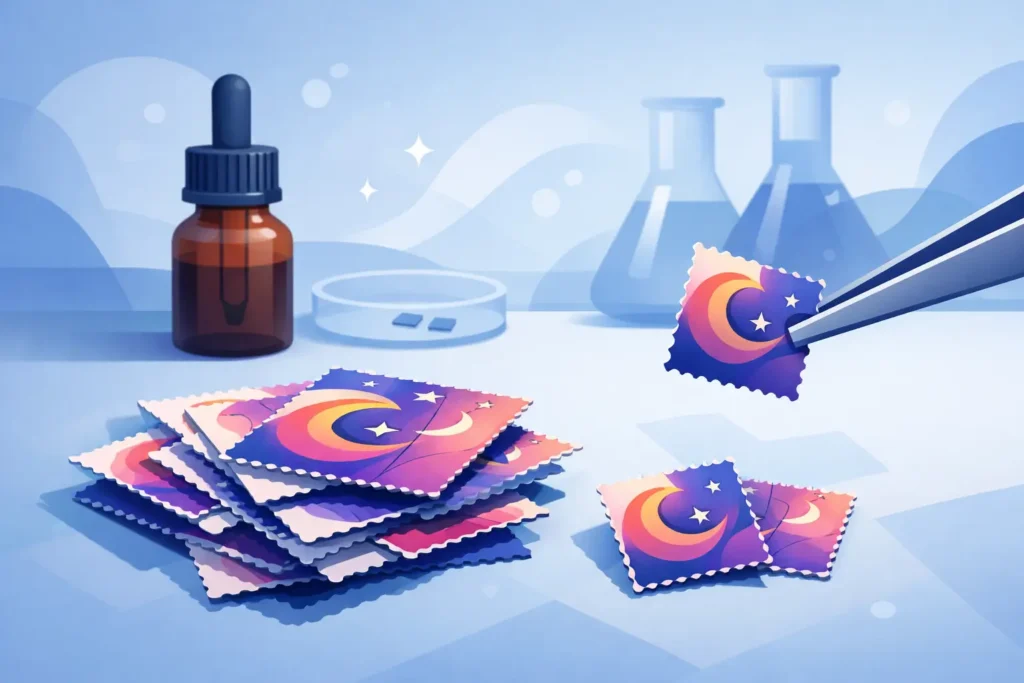
If you want to know how to microdose 1cP LSD blotters in a way that actually stays consistent, volumetric dosing is the cleanest option. The idea is simple. You dissolve one blotter of known strength into a measured amount of liquid, then measure your dose from that liquid with a dropper or oral syringe.
This gives you far more control than cutting paper into tiny fractions. It also makes dose adjustments easier. Instead of jumping from one awkward blotter fragment to another, you can move up or down in small, deliberate increments.
Use distilled water or a high-proof clear alcohol depending on your setup and storage plan. A small amber glass bottle helps protect the solution from light. Once you know the tab strength and the total liquid volume, the math becomes straightforward.
For example, if one blotter contains 100 micrograms and you dissolve it in 10 milliliters of liquid, each milliliter contains 10 micrograms. If you want a 5 microgram test dose, you would measure 0.5 milliliters. That is the kind of precision that keeps your research clean.
Label the bottle clearly. Store it somewhere cool, dark, and undisturbed. Sloppy storage creates sloppy results.
What you need for a reliable setup
Keep it simple and controlled. A known-strength 1cP-LSD blotter, a measured liquid medium, a glass container with a seal, and a syringe or dropper marked in milliliters are enough for most people. The point is not building a lab bench. The point is removing guesswork.
Avoid improvising with random kitchen tools if precision is the whole reason you chose volumetric dosing. A proper oral syringe costs very little and gives you cleaner repeatability.
Start lower than you think you need
This is where a lot of people get impatient. They read someone else’s preferred range, skip the low-end test, and then spend the day slightly over the line. That does not prove the product is strong. It proves they started too high.
If you are new to 1cP-LSD, begin with the smallest dose that is still meaningful to track. For many users, that means around 5 micrograms. Then wait, observe, and log the result before making adjustments on a later session.
Do not scale up mid-day because you feel “almost there.” That is a good way to blur your data. One dose, one observation window, one record.
Signs your microdose is too high
The clues are usually obvious once you know what to watch for. You may feel wired, restless, distractible, emotionally amplified, or unusually sensitive to light and stimulation. Some people describe it as being stuck halfway between productive and too switched-on.
That is not ideal microdosing. That is overshooting.
A good microdose tends to sit quietly in the background. You should still be able to work, communicate, and move through a normal day without feeling pushed around by the dose.
Timing matters more than people admit
Take your dose early. That is the safest default for most schedules. Even low doses of lysergamide-type compounds can carry a stimulating edge, and dosing too late can drag into the evening in ways you did not plan for.
Consistency matters here too. If you dose at 7 a.m. one day and 1 p.m. the next, comparing outcomes gets messy. Keep the timing stable so your notes actually mean something.
There is also the question of frequency. Some people prefer every third day. Others use a fixed schedule with more spacing. There is no single universal protocol that works for everybody, which is why tracking matters more than copying somebody else’s template. More frequent is not automatically better. Sometimes more spacing produces cleaner results and less tolerance buildup.
Track effects like you mean it
If you are serious about figuring out your ideal microdose, keep a log. Not a vague mental note. An actual record. Write down dose, time, food intake, sleep quality, stress level, and what you noticed over the next several hours.
This matters because context changes the experience. A dose that feels smooth after a full night of sleep may feel edgy when you are underslept, over-caffeinated, or dealing with a packed day. If you do not track those variables, you can end up blaming the dose for what was really a bad setup.
Short entries are enough. The point is pattern recognition. After a few sessions, you will usually see where your range actually sits.
Storage, stability, and basic handling
Heat, light, air, and moisture are not your friends here. Keep blotters and prepared solutions stored with care. That means a cool, dark place, minimal unnecessary handling, and containers that close properly.
If you are handling blotters directly, use clean dry hands or tools. If you are using a solution, keep the bottle sealed when not in use and avoid contaminating it with unclean droppers or contact points. Precision starts with the dose, but it also depends on preserving the material properly.
This is one reason buyers tend to prioritize lab-tested, consistent product in the first place. A reliable source reduces one layer of uncertainty, and your dosing method reduces the next. Sites like Official Chemistry King lean into that logic for a reason – quality in, cleaner research out.
The real trade-off: convenience versus precision
There is no shortage of people who want the fastest route. Cut the tab, guess the fraction, move on. If that works for them, fine. But if your goal is controlled microdosing, that shortcut has limits.
Volumetric dosing takes a little setup. In return, you get tighter control, smoother adjustments, and more trustworthy results. That is usually the better bargain.
And if your first few sessions feel underwhelming, that is not failure. That is often exactly where you want to begin. You can always increase carefully later. It is much harder to reverse an overdone day once it is already moving.
Microdosing works best when you treat it like a calibration process. Stay precise, stay patient, and let the data tell you where your real dose lives.